
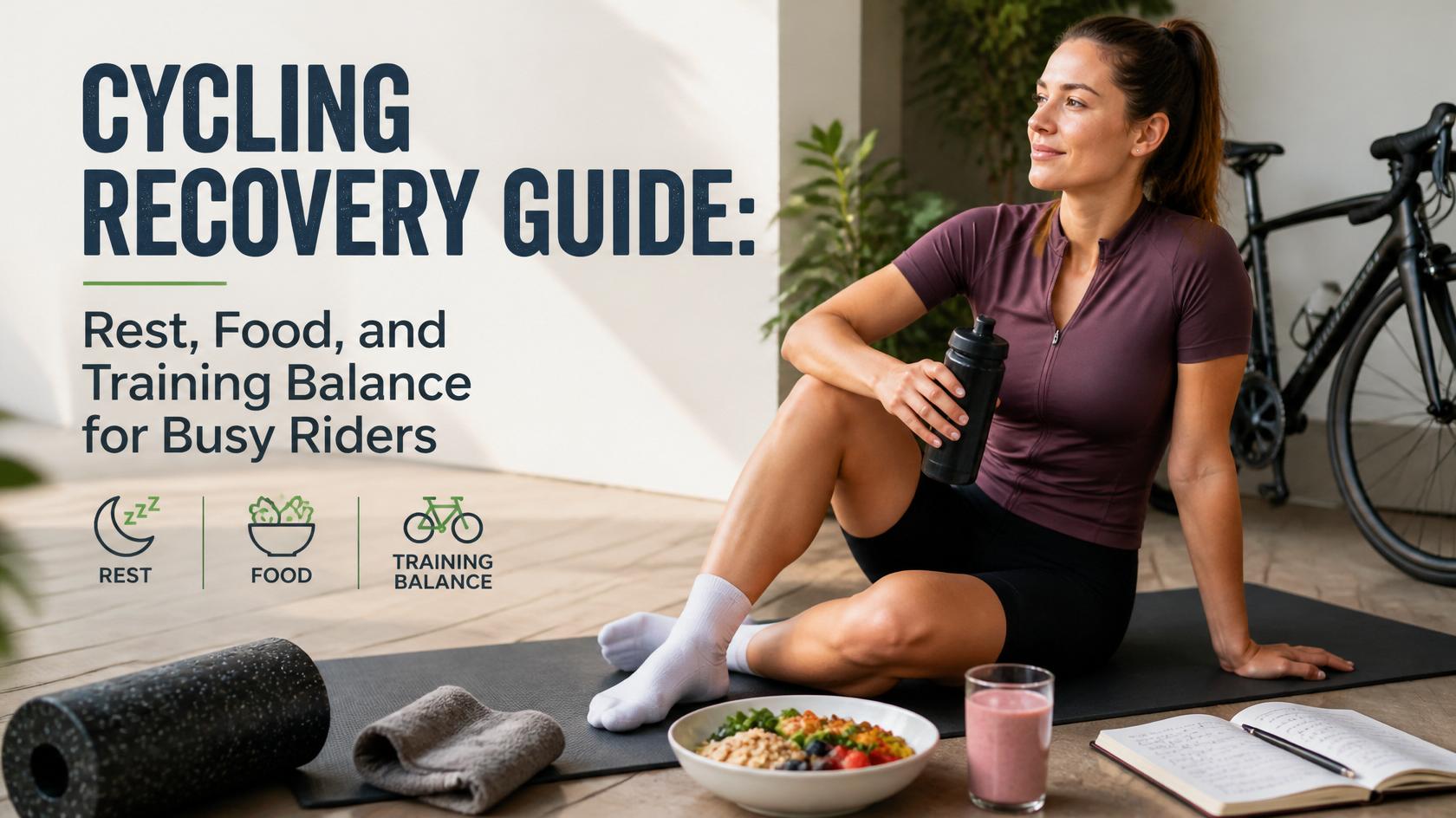
You don’t get fitter on the bike—you get fitter when you recover from what you did on the bike.
For busy riders who also lift, work full-time, and have a family, recovery is often the missing piece. You can’t just “do more” forever. You need rest, food, and smart scheduling to actually absorb your training.
This guide is a practical recovery plan for cyclists who live in the real world: limited time, lots of responsibilities, and big goals.
What Recovery Really Means (Not Just “Days Off”)
Recovery isn’t just “not riding.” For a busy cyclist who trains, lifts, and works, recovery includes:
- Rest: sleep, days off, easy days, time off your feet
- Food: enough total energy and protein, plus smart post-ride meals
- Hydration: replacing fluids and electrolytes
- Training balance: how you schedule hard and easy days
- Stress management: work, family, and general life load
If your life load is high, you need your training load and recovery to be smarter—not more complicated.
Sleep & Rest Basics for Busy Riders
Sleep is your biggest recovery tool. Most active adults do better aiming for:
- 7–9 hours per night when possible
- Protecting at least one true rest day per week (no hard training)
If 8–9 hours feels impossible, think in upgrades, not perfection:
- Consistent bedtime and wake time most days
- 10–15 minutes of “wind-down” without screens before bed
- Keeping caffeine earlier in the day, especially on heavy training days
As a busy rider, it’s better to plan slightly fewer hard sessions and actually recover than to stack everything and stay exhausted.
Food & Hydration: Supporting Recovery Without a Perfect Diet
Key recovery nutrition habits:
- Post-ride meal within 1–2 hours: carbs + protein (e.g., rice bowl with chicken and veggies, pasta with lean meat sauce, omelet with potatoes and fruit).
- Daily protein: spread across the day (e.g., 20–30+ g at each meal) to support repair and adaptation.
- Carbs on ride days: enough to fuel training and refill glycogen; more on big ride days, less on rest days.
- Hydration: roughly 500–800 ml per hour of riding, plus regular fluids afterward, adjusting for heat and sweat.
For specifics, see my Beginner Cycling Nutrition guide and my What to Eat After a Ride article, where I break down post-ride meals and hydration in more detail—and show how I track it all in MyFitnessPal.
Weekly Training Balance: Hard, Easy, and Rest Days
Recovery is also about how you structure your week.
For a busy rider who cycles and lifts, a simple pattern might look like:
- 2–3 cycling days (one longer, one harder, one easier)
- 2 strength sessions (full body or lower/upper splits)
- 1–2 true rest or very easy days (short walks, light mobility)
Principles to keep in mind:
- Don’t stack all hard things on the same day every week.
- Follow a hard day with at least a moderate or easy day.
- Use rest days as actual rest—not “catch up on everything plus a surprise workout.”
Example real-life week:
- Mon: Strength (moderate)
- Tue: Easy ride (short, conversational)
- Wed: Hard ride or intervals
- Thu: Strength (moderate)
- Fri: Rest or short walk/stretch
- Sat: Longer ride (moderate)
- Sun: Rest, family, light movement
You can adjust the days, but the structure—alternating load and recovery—is the important piece.
Free and “On-the-Couch” Recovery Habits
Not everything has to be fancy. Some of the best recovery tools are free or close to it:
- Walking: short walks on non-riding days or after rides to help circulation and stiffness.
- Gentle mobility/stretching: 5–10 minutes after rides or in the evening (hips, hamstrings, calves, upper back).
- Feet up on the couch: simple leg elevation to help with swelling and fatigue after hard sessions.
- Light core/activation work: 2–3 short routines per week to support posture and reduce aches, without becoming another full workout.
These are easy to layer into life between meetings, family time, or Netflix. The point isn’t perfection; it’s consistency.
Higher-End Recovery Tools: Normatec & Sauna
Once you have the basics (sleep, food, hydration, training balance) somewhat dialed in, higher-end tools can become helpful “nice-to-have” additions.
Normatec Compression Legs
Normatec and similar compression systems:
- Use pulsing compression along the legs to promote circulation and venous return
- Can help reduce feelings of heaviness and soreness after hard or long sessions
- Are particularly attractive if you train frequently and don’t always have time for longer recovery routines
Because they’re a higher-cost investment, frame them as:
If you’re training regularly, stacking cycling and strength, and you value recovery time at home, compression systems like Normatec can be a helpful “extra” layer of support. They do not replace sleep, food, and smart scheduling—but they can make heavy training weeks feel more manageable.
Sauna (Especially for Fall, Winter, and Spring)
Sauna sessions:
- Can support relaxation and stress reduction
- May help with circulation and perceived recovery
- Can be used in some protocols for heat adaptation, but for most busy riders they’re mainly a recovery and wellbeing tool
In hot Georgia summers, my rides themselves are plenty “heat adapted.” I plan to use a sauna more in fall, winter, and spring as part of my recovery and relaxation routine. It’s another tool that can help you unwind and support circulation, but—as always—it works best when layered on top of good sleep, nutrition, and training balance.
Signs You Need More Recovery (And What to Do)
A few practical signs that recovery might be lacking:
- Persistent fatigue even on easy days
- Trouble sleeping despite being “tired”
- Drop in performance or motivation
- More irritability or feeling “snappy”
- Random aches that don’t fade with a day or two easy
If you notice these:
- Add or protect a true rest day.
- Make at least one hard session moderate for a week or two.
- Check your sleep and calories/protein—are you under-eating relative to your training?
- Use your simple recovery tools (walking, mobility, leg elevation) more consistently.
Most busy riders benefit from small adjustments rather than drastic overhauls.
Using Tracking Tools Without Obsessing
- MyFitnessPal: helps you see if you’re roughly meeting your protein and calorie needs, and if you’re fueling ride days more than rest days.
- Wearables (e.g., Garmin): can track sleep, heart rate, training load, and recovery metrics.
The key is:
- Look at trends (e.g., consistently poor sleep, elevated resting heart rate, frequent “unproductive” training tags), not every single data point.
- Use the data to inform small changes (extra rest, earlier bedtime, more fuel), not to beat yourself up.
Where to Go From Here
You don’t need perfect recovery habits to make progress. You need:
- Enough sleep
- Reasonable food and hydration
- Sensible training balance
- A few simple movement and relaxation habits
- Optional tools like Normatec and sauna layered on top, if they fit your budget and lifestyle
Leave a Reply